
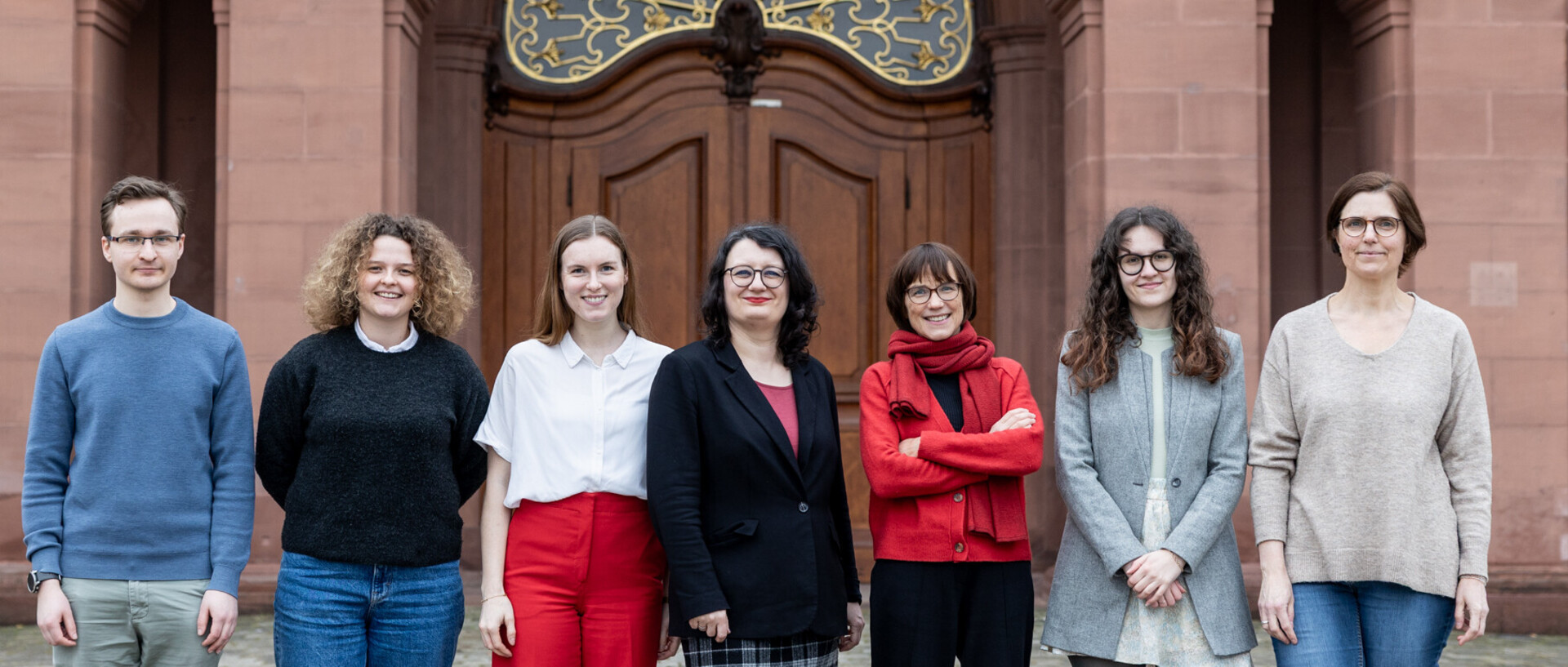
Team
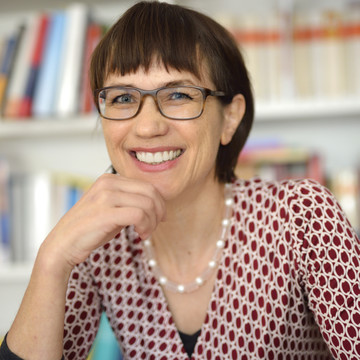
Prof. Dr. Annette Kehnel
Chair of Medieval History
L 7, 7 – Room 107
68161 Mannheim
By appointment
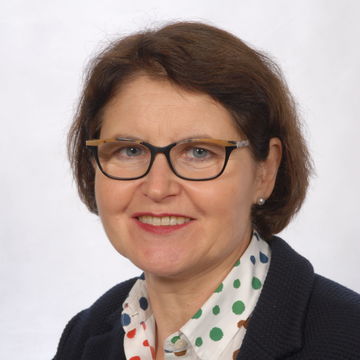
Prof. Dr. Maria-Magdalena Rückert
Chair of Medieval History
L 7, 7
68161 Mannheim
By appointment.
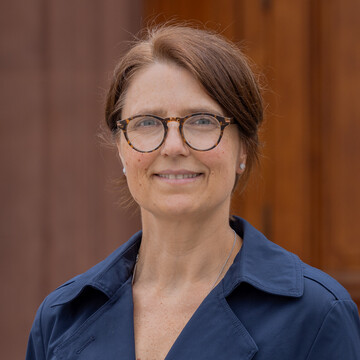
Katja Gutzmer
Chair of Medieval History
Chair of Late Medieval and Early Modern History
L 7, 7 – Room 102
68161 Mannheim
Tuesdays to Thursdays 9am to 5pm at the institute. Mondays and Fridays 9am to 5pm via mail and MS-Teams.
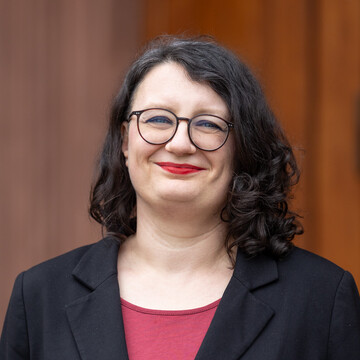
PD Dr. Julia Bruch (she/her)
Chair of Medieval History
L7, 7 – Room 101
68161 Mannheim
see Bookingtool
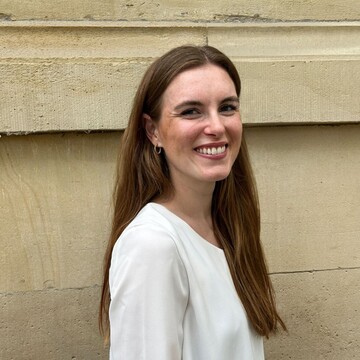
Dr. des. Verena Weller
Chair of Medieval History
L 7, 7 – Room 108
68161 Mannheim
by appointment, inquiry per e-mail
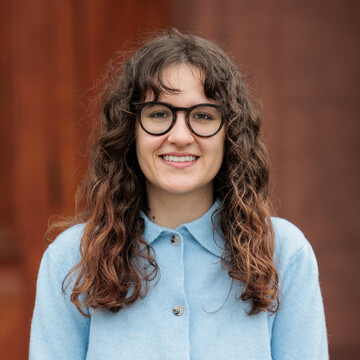
Sophie Henle, M.A. (she/her)
Junior Professorship for Economic History of the Middle Ages
L 7, 7
68161 Mannheim
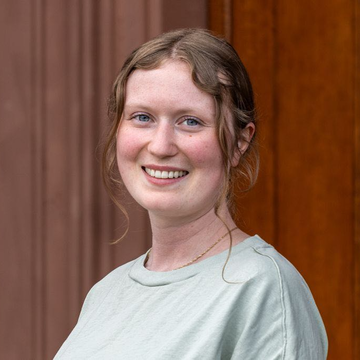
Emma Miller-Hund, M.Ed.
Lehrstuhl für Mittelalterliche Geschichte
L 7, 7
68161 Mannheim
by appointment

Helena Dobler
Chair of Medieval History
L7,7 – Room 301
68161 Mannheim

Anna Lisa Müller, B.A.
Lehrstuhl für Mittelalterliche Geschichte | Lehrstuhl für Geschichte des Spätmittelalters und der frühen Neuzeit
L 7, 7 – Room 301
68161 Mannheim
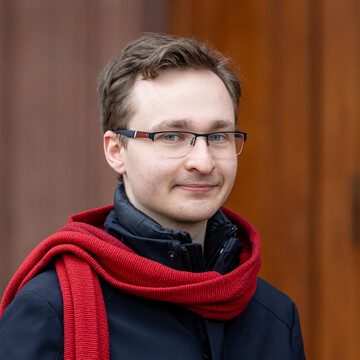
Tim Schnatterer, B.A. (he/him)
Chair of Medieval History
L 7, 7
68161 Mannheim
Alumni
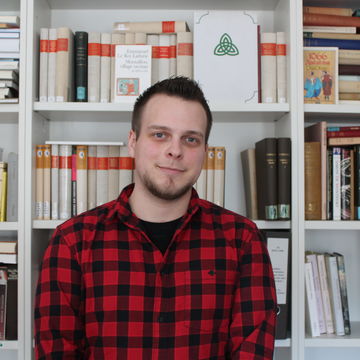 Credit: Sophie Henle
Markus Schniggendiller, M.A.
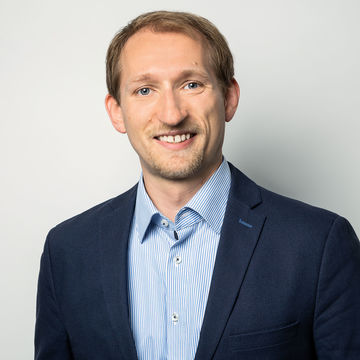 Credit: S. Nicolussi-Köhler
Dr. Stephan Nicolussi-Köhler
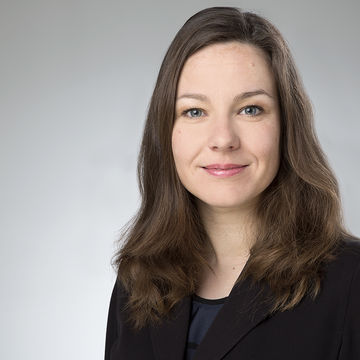 Credit: T. Skambraks
Prof. Dr. Tanja Skambraks
 Credit: LSE
Dr. Alex Spike Gibbs
Lecturer in Medieval European Economic and Social History, at King's College LondonE-mail: spike.gibbs(at)kcl.ac.uk Credit: Salome Egloff
Dr. Salome Egloff (she/her)
Senior Assistant at the University of Luzern
Gastwissenschaftler*innenprogramm Nachhaltigkeit
Our team welcomed within the „Gastwissenschaftler*innenprogramm Nachhaltigkeit“ multiple visiting scholars. The goal of this initiative is to facilitate international scholarly exchange among experts, thereby enhance innovative resaerch and teaching in the critical field of sustainability.
Daniel Samson
 Credit: Daniel Samson
Brock University, St. Catharines, Canada
• Associate ProfessorResearch interests:
Social and enviromental history in Maritime Canada
Settler colonial societiesDaniel Samson works on rural, social and environmental history in Maritime Canada in the 18th and 19th centuries. His teaching focuses broadly on political and economic relationships in settler colonial societies. He teaches courses on the colonial Atlantic World, as well as a first-year course on the global history of climate change. He has also developed open-access courses that encourage historical thinking and digital methods, one on the history of the Atlantic World and another on settler colonialism. In Mannheim, he will present from his new research on the 18th-century French colony of Isle Saint-Jean, particularly relations between the French [Acadian] settlers and the Indigenous Mi’kmaq peoples, their agricultures and their resources-use strategies.
He has published The Spirit of Industry and Improvement: Liberal Government and Rural-Industrial Society, Nova Scotia, 1790-1862 (Kingston and Montréal, McGill-Queen’s University Press, 2008), and is currently completing a biography of a 19th-century Nova Scotia miller, printer, diarist and iconoclast, James Barry, tentatively titled James Burns Barry: Constructing a Self in a Nineteenth-Century Diary. An essay, “Poussière de moulin et le corps: James Barry, 1849-1906”, will appear later this year in Renaud Bécot, Romain Grancher, et Judith Rainhorn eds., La sueur et la poussie: une histoire environnementale des mondes du travail (Toulouse, Éditions Anacharsis).
Dr. Ingrid Makus
 Credit: Ingrid Makus
Brock University, St. Catharines, Canada
• Associate Professor for Political Science, Dean of the Faculty of Social SciencesResearch interests:
Feminist political theory
Gender representation in the history of political thought
Dr. Ingrid Makus is a political philosopher who has published in the area of feminist political theory and gender representation in the history of political thought, focusing on early modern and modern thinkers such as Thomas Hobbes, John Locke, J.J. Rousseau and J.S. Mill. Her current research project draws on Hobbes’s conception of a distinction between giving birth and giving life and the state’s role in ensuring generational continuity as a starting point for formulating and understanding the broader debate about what constitutes genocide. Her particular focus is on the issue of state policies in Canada as a form of Indigenous genocide. Dr. Makus is Dean of the Faculty of Social Sciences at Brock University, a position she’s held since 2016 (on research leave for autumn 2025). Her book, Women, Politics and Reproduction: The Liberal Legacy (University of Toronto Press, 1996) is a significant contribution to debates on gender in modern political thought.
Dr. Mirjam Hähnle
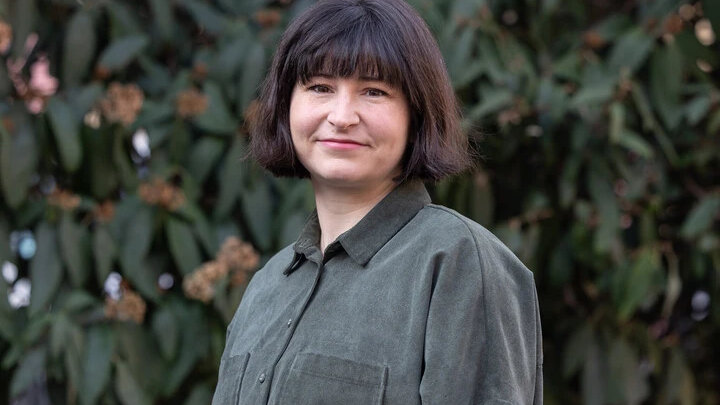 Credit: Alexander Münch
London, GHIL
• Research fellow, fellowship programmeResearch interests:
Early modern resource imaginaries
Utopian thinking
Environmental history of the city
Historical concepts of time
History writing and the climate crisis
In the spring/
summer semester of 2025, we welcomed Dr. Mirjam Hähnle as the instructor of the main seminar “Green, Spirited, Far Away. Utopian Ideas about People and Nature, 1400–1800.” Her seminar explored utopian visions of the coexistence between humans and their environment, fostering a deeper understanding of premodern human-environment relationships. Through her research on utopian thought, early modern imaginations of resources, urban environmental history, historiography, and the climate crisis, she makes a significant contribution to the sustainability discourse. For her commitment, she was nominated for the Teaching Excellence Awards 2021 at the University of Basel (“Future Talents” & “Service to Teaching”) and received the Research Grant from the Vögelin-Bienz Foundation of the Basel State Archives. Publications – A Selection
Hähnle M., Schober S. and Schürch I. (2023). Nachhaltigkeit im Buch. Ein Gespräch mit Milo Probst und Annette Kehnel. In: Traverse: Zeitschrift für Geschichte = Revue d'histoire 30 (2), pp. 154–64.
Hähnle M. and Cronjäger L. (2025). Der Hardwald. Ein politischer Aushandlungsraum zwischen Stadt und Land, Waldweide und Chemieindustrie. In: Esther Baur/
Lina Gafner. Städtischer Raum: offen und begrenzt, gestaltet und umkämpft (=Stadt.Geschichte.Basel vol. 9), Basel: Christoph Merian Verlag, pp. 84–100. Prof. Dr. Geneviève Dumas
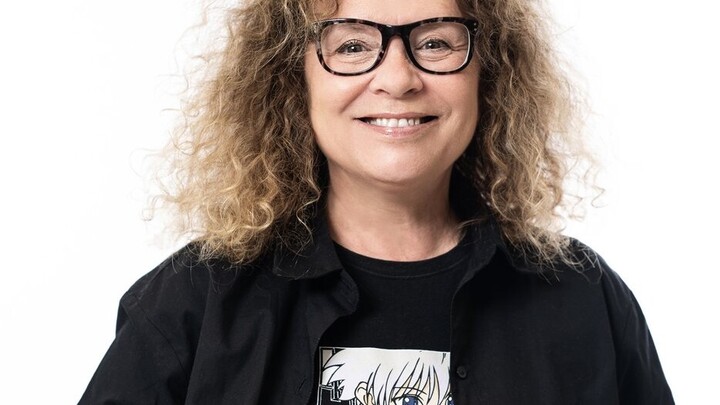 Credit: UdS
Université de Sherbrooke, Kanada
• Teaching professor for Medieval HistoryReseach interests:
History of Medicine
Medieval History
History of the Middle East
Islamic and Byzantine History
Medical History
Mediterranean History
In presentations on her research project „Environment, Climate and Space in Montpellier and its Lagoon Hinterland 13th–17th Centuries”, Prof. Dr. Geneviève Dumas talked about water supply and consumption in and around Montpellier in the late Middle Ages. The focus on the resource water as well as her interdisciplinary research, which emphasizes health as a central aspect, demonstrates how closely sustainability is linked to individual health. She was honored with the Dean’s Honor’s List at McGill University (2000) and with the Prix Harold S. Segall for outstanding presentation of medical history research, awarded by the Congress of Health Sciences in Montréal (1995).Publications – A Selection:
Dumas G. (2014). Santé et société à Montpellier à la fin du Moyen Âge (=The Medieval Mediterranean 102). Schöningh: Fink, Brill.
Dumas G. (2013). Un registre de comptes à Montpellier au XVe siècle: nouveau regard sur l'organisation communale médiévale. In: Bulletin historique de la ville de Montpellier 35, pp. 48–61.
Prof. Dr. Sabine von Mehring
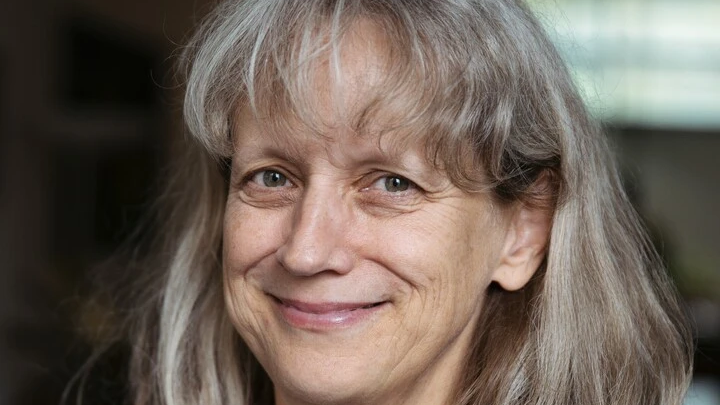 Credit: Brandeis University
Brandeis University in Waltham, USA
• Professor of German and Gender Studies, Director of the Center for German and European StudiesResearch interests:
German as a foreign language
Jewish-German dialogue
German women writers
German cinema and drama
Fairy tales
Climate change and the humanitiesIn the fall/
winter semester 2022 Prof. Dr. Sabine von Mehring gave a variety of presentations and lectures on “Climate Activism in Research and Teaching.” Her work has already attracted attention in the past, shown by her numerous awards, scholarships, and grants received, such as the Volkmar and Margret Sander Prize (2022) and the Public Voices Fellowship of the Yale University (2023). Through various articles, book chapters, reviews, her work on the Handbook of Global Climate Activism, and much more, Prof. Dr. von Mehring draws attention to antisemitism and climate change, as well as climate activism. Her research on climate change is an important contribution to the humanities, particularly in the field of sustainability. Publications – A Selection:
Von Mehring S. and Gheorghiu A. (2024). No Greenwashing of Fossil Gas – Creating a Grassroots Transatlantic Climate Bridge Against False Solutions. In: S. von Mehring u. a. (Ed.). Routledge Handbook of Grassroots Climate Activism (=Routledge International Handbooks), Part 6 (30).
Von Mehring S. (2023). Promise Motivation: Films with Good News About Climate Change. In: Canadian Journal of Film Studies 32 (2), pp. 35–60.