


Workshops and Conferences
Past Workshops
New Ideas on Normativity
New Ideas on Normativity
International Conference, Mannheim, January 22–24, 2026
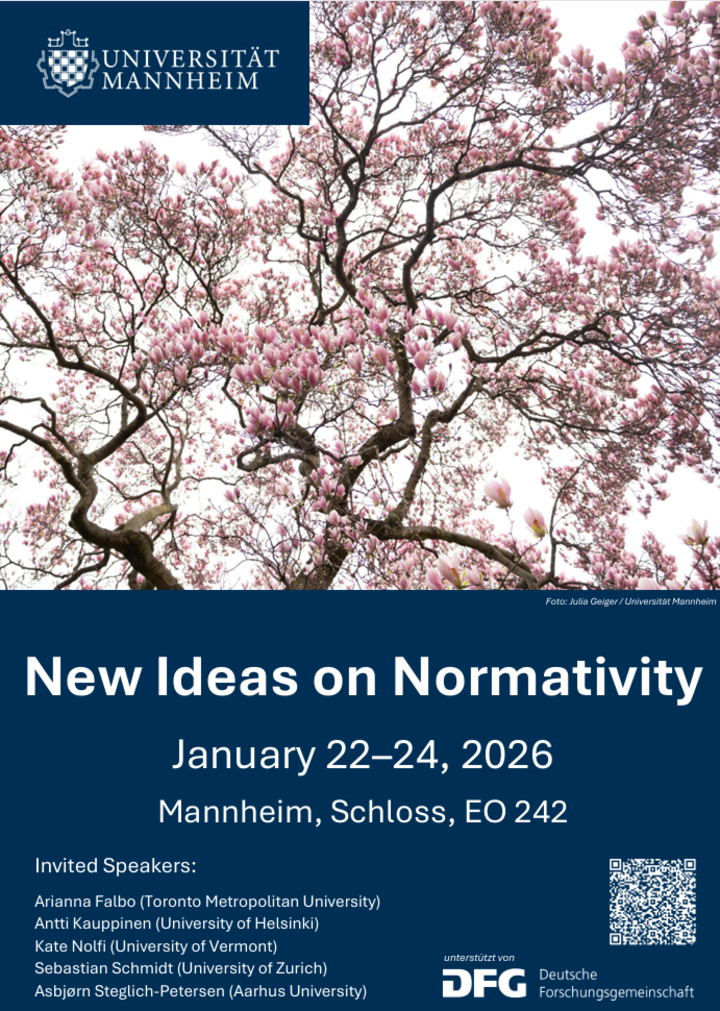 Credit: Julia Geiger, Universität Mannheim
Norms are constraints on actions, beliefs, or intentions. They guide us, among other things, in satisfying desires, in being morally upright, or in acquiring knowledge. However, it is not easy to see what different kinds of norms there are, how different kinds of norms are linked to each other, and how we should deal with norm conflicts. In particular, so-called epistemic norms, which somehow pertain to the formation, maintenance, or revision of beliefs, are in many ways hard to align with moral or prudential norms, which concern more practical matters.
At the conference, we will discuss novel insights and ideas on questions like the following:
- How do norms, reasons, and values relate to each other? Are they rooted in our actual aims and desires, or are they largely independent of what we in fact feel and want?
- How do moral, prudential, epistemic, and other kinds of norms relate to each other? For instance, do we have non-moral and non-prudential reasons to comply with epistemic norms, or are epistemic norms merely instrumentalist in the sense that they depend on non-epistemic aims?
- What kinds of norms govern such activities as making assertions or inquiring into the truth of some proposition? More generally, to what activities do moral, prudential, and epistemic norms respectively extend?
- Is there a way to balance norms of different kinds, and if yes, how? Is there something like an all-things-considered ought, and if yes, how can it integrate moral, prudential, social, and epistemic requirements?
- When are we to blame for violating norms? Is there a distinctive epistemic kind of blame? And what are the interrelations between blame, responsibility, and direct voluntary control over actions, intentions, and beliefs?
- Are our most essential norms internalist (subjectivist) or externalist (objectivist) requirements? How much internalism is needed to preserve their guidance function, and how much externalism is needed to deal with otherwise counterintuitive consequences?
Keynote Speakers:
Arianna Falbo (Toronto Metropolitan University)
Antti Kauppinen (University of Helsinki)
Kate Nolfi (University of Vermont)
Sebastian Schmidt (University of Zurich)
Asbjørn Steglich-Petersen (Aarhus University)Programme
The programme of the conference is here (PDF, 155 kB).
Location:
University of Mannheim, Schloss, EO 242
Organization:
This conference was part of the project The Moral Dimension of Doxastic Norms, which is funded by the German Research Foundation (DFG).
Varieties of Philosophical Expressivism
Varieties of Philosophical Expressivism
International Conference

19–21 May 2022
University of Mannheim
Schloss, Room O 138 | ZOOMThe conference was originally planned for May 2020 but was postponed due to the Covid-19 pandemic.
Philosophers have become increasingly interested in expressivist views within various subfields such as ethics, aesthetics, epistemology, the philosophy of language and logic, and the philosophy of mind. What unites these views is the idea that affirmations about a certain subject matter are not, or not primarily, descriptions of a mind-independent reality, but serve to express the speakers’ mental states. It is, however, a controversial matter what this means exactly and what it implies. What are the formal, what are the logical properties of the notion of expression? Can one express a mental state one does not possess? And what, if any, are the semantic or pragmatic consequences of adopting an expressivist position? For example, are there any genuinely expressivist views that can plausibly be combined with classical truth-value semantics, and if so, are they restricted to specific classes of claims?
The conference is organised by members of the project Mind the Meaning: The Philosophy of Psychological Expressivism.
The conference program is available here: https://www.uni-mannheim.de/mind-the-meaning/events/
The talks and discussion will be live broadcasted via ZOOM. The respective ZOOM-links will be made available an hour before the event starts at: https://www.uni-mannheim.de/mind-the-meaning/events/.
Attendance is free, please register: sandra.ebertuni-mannheim.de
Varieties of Philosophical Expressivism (cancelled due to the Covid-19 pandemic)
Varieties of Philosophical Expressivism
International Conference

*CANCELLED DUE TO THE COVID-19 PANDEMIC. RESCHEDULED FOR 19–21 MAY 2022.*
14–16 May 2020
University of Mannheim
O 138 Fuchs-Petrolub-Festsaal
Schloss Eastwing, 1st FloorIn the last decades, philosophers have become increasingly interested in expressivist views within various subfields such as ethics, aesthetics, epistemology, the philosophy of language, the philosophy of mind, and the philosophy of law. What unites these views is the idea that affirmations about a certain subject matter are not, or not primarily, descriptions of an underlying reality, but serve to express the speakers’ mental states. It is, however, a controversial matter what this means exactly and what it implies. What are the formal, what are the logical properties of the notion of expression? Can one express a mental state one does not possess? And what, if any, are the semantic, what are the pragmatic consequences of adopting an expressivist position? For example, are there any genuinely expressivist views that can plausibly be combined with classical truth-value semantics, and if so, are they restricted to specific classes of claims?
In the conference, we aim at identifying structural similarities (as well as differences) between the distinct strands of expressivism in order to shed light on, among other things, the notion of expression, the conceptual and semantic challenges that expressivists face, and the merits and drawbacks of expressivist theories in general.
Confirmed speakers:
Stephen Barker
Felix Bräuer
Joachim Bromand
Matthew Chrisman
Stephen Finlay
Wolfgang Freitag
Vera Flocke
Luca Incurvati
Teresa Marques
Christa Peterson
Benjamin Schnieder
Mark Schroeder
Michael Scott
Jack Woods
Nadja-Mira YolcuThis conference is organized by members of the project Mind the Meaning: The Philosophy of Psychological Expressivism.
36th Berlin Forum of Business and Corporate Ethics
Workshop
19–20 July 2019
University of Mannheim
EW 169Program (PDF, 102 kB)
The Berlin Forum is a network for business and corporate ethics that was founded more than ten years ago. The Forum brings together doctoral students and postdocs from different disciplines in an open working atmosphere about once a year to exchange ideas on their current research, drafts and conceptual ideas. The Berlin Forum aims to discuss lines of argument and contributions to normative questions of economic activity from different research perspectives among doctoral students and postdocs. Philosophers, economists, economic ethicists and business ethicists alike discuss topics that are negotiated under the keywords CSR and sustainability as well as in corporate and business ethics. Participation is possible with a talk or as a discussion without a talk. Each slot lasts one hour in total for both talk and discussion (20 minutes talk, 40 minutes discussion).
Perspectives on First-Person Thought
Internationale Conference
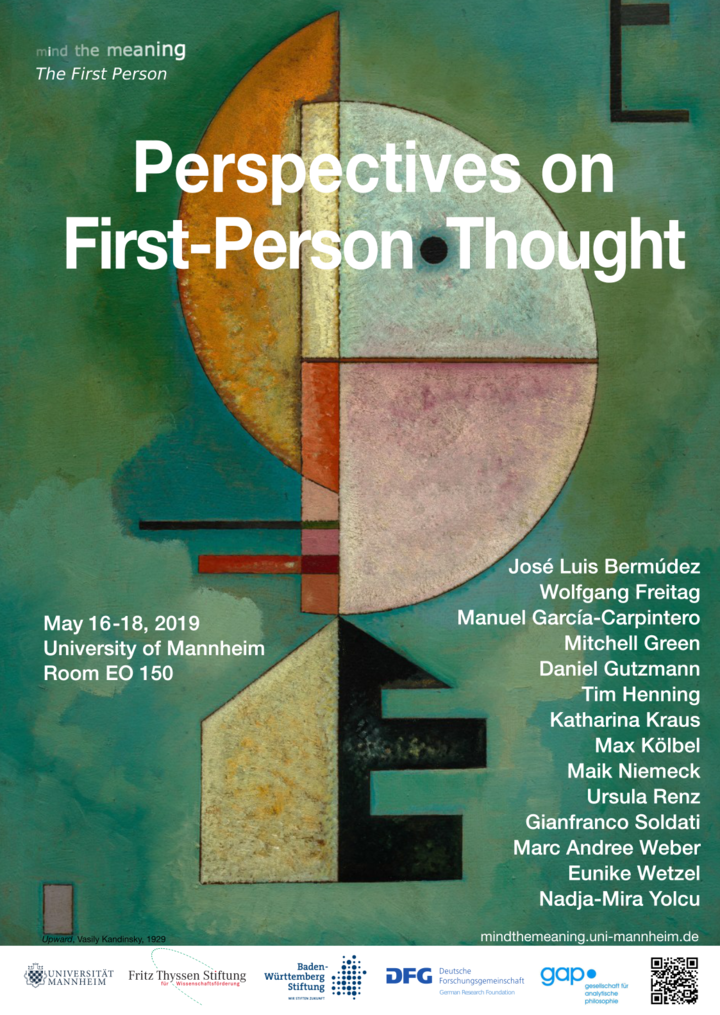
16–18 May 2019
University of Mannheim
EO 150Program (PDF, 162 kB)
You can find more information here.
Is there anything special about the way we think about ourselves, and in particular about our own inner world? It is sometimes said that thoughts about our own conscious states involve a kind of awareness that is fundamentally different from the one that comes with other thoughts. It is also often held that we cannot misrepresent the subject of our current expreriences, and that this phenomenon must be explained by an adequate theory of first-person thought. Yet it is difficult to discern what exactly these claims entail. Moreover, there is no unconctroversial way to relate phenomena of first-person thought to phenomena of first-person speech. When we utter self-ascriptions of mental states, do we thereby simply report in which state we are, or do we rather directly express the respective state?
Our aim in this conference is to bring together researchers – including philosophers, linguists, and psychologists – who will address and dicuss these and other problems relating to first-person thought and the way it is articulated in speech.
The conference will be the concluding event of the project The First Person – Semantic, Epistemic, and Scientific Perspectives (PI: Prof. Dr. Katharina Kraus, University of Notre Dame) and the inaugural conference of the project Mind the Meaning: The Philosophy of Psychological Expressivism (PI: Prof. Dr. Wolfgang Freitag).Suspension of Belief
International Conference
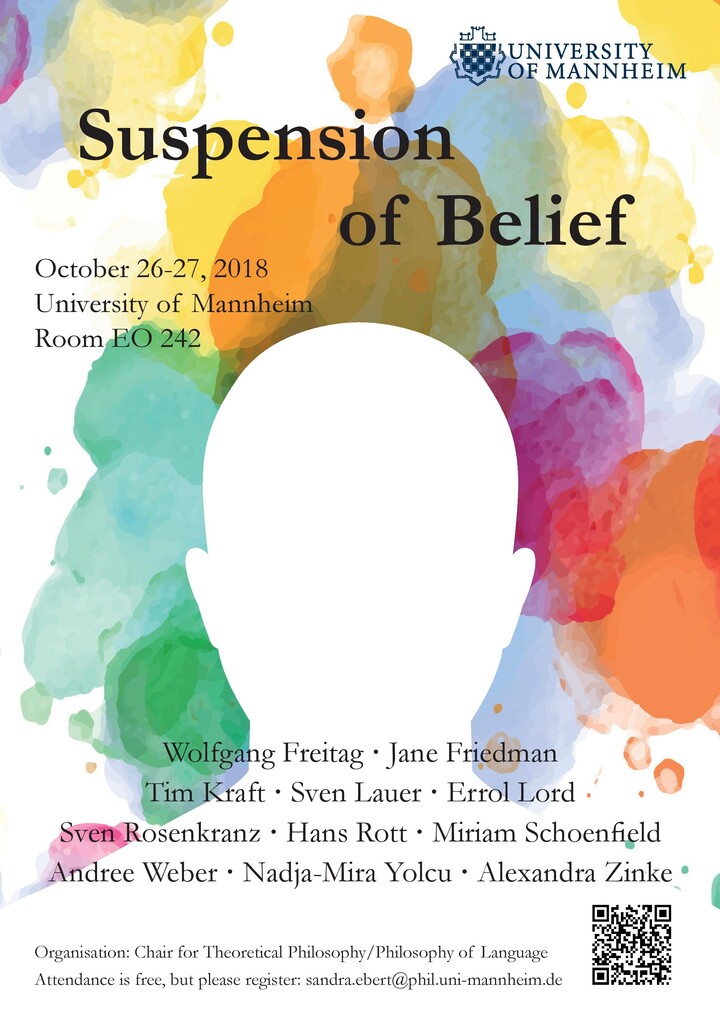
26–27 October 2018
University of Mannheim
EO 242Program (PDF, 141 kB)
We often suspend belief. Some questions we haven't considered yet, others are still under investigation, and yet others seem to allow for no definite answer. We often withhold belief and, more importantly, we do so rationally. Despite its core role in our doxastic everyday life, suspension of belief has not received much attention in the epistemological literature, which has mainly focused on positive belief alone. The conference will fill this lacuna and investigate the nature and rational profile of suspension of belief.