
Forschung
Forschungsprojekte und Kooperationen
Reading the Climate Crisis
A Study on the Effects of Reading Climate Fiction
Our present is shaped by the climate crisis and its far-reaching consequences. This crisis is reflected across diverse media narratives, with literary works on climate change often grouped under the label climate fiction(cli-fi). Typically found in popular and genre fiction, including science fiction and fantasy, cli-fi is characterized by its focus on the climate crisis as either a central theme or a narrative backdrop.
Although cli-fi has gained visibility and relevance in recent years, little is known about its actual impact on readers. As Schneider-Mayerson notes, “the large body of research on narrative persuasion supports the speculations of environmental scholars that climate fiction stories could have significant persuasive effects on readers’ beliefs, attitudes, and behaviors” (2023, 37). In collaboration with the Max Planck Institute for Empirical Aesthetics, this study takes up an underexplored dimension of research by examining the potential effects of climate fiction under research conditions that include the reading of complete novels.
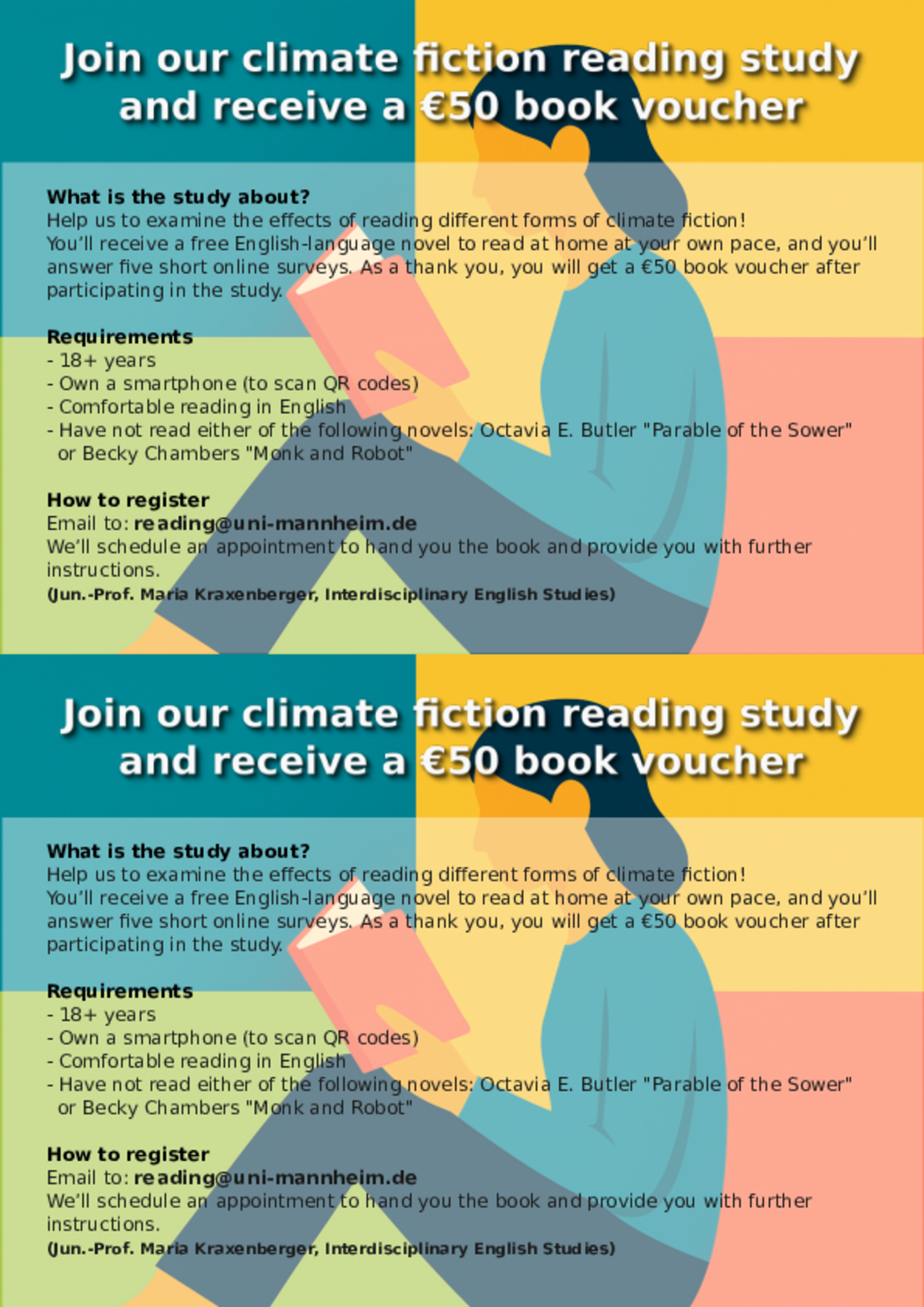
Interested in taking part? We are currently inviting participants to join our study.
Email: readinguni-mannheim.de
We will schedule an appointment to hand you the book and provide further instructions.
Veröffentlichungen
- Kraxenberger, M. und Lauer, G. (2022). Wreading on online literature platforms. Written Communication, 39, 462–496.
- Knopp, C. A., Blohm, S., Kraxenberger, M. und Menninghaus, W. (2021). How perfect are imperfect rhymes? Effects of phonological similarity and verse context on rhyme perception. Psychology of Aesthetics, Creativity, and the Arts, 15, 560–572.
- Kraxenberger, M., Knoop, C. A. und Menninghaus, W. (2021). Who reads contemporary erotic novels and why? Humanities and Social Sciences Communications, 8, 1–13.
- Rebora, S., Boot, P., Pianzola, F., Gasser, B., Herrmann, J. B., Kraxenberger, M., Kuijpers, M. M., Lauer, G., Lendvai, P., Messerli, T. C. und Sorrentino, P. (2021). Digital humanities and digital social reading. Digital Scholarship in the Humanities : DSH, 36, ii230-ii250.
- Blohm, S., Kraxenberger, M., Knoop, C. A. und Scharinger, M. (2021). Sound shape and sound effects of literary texts. In Handbook of empirical literary studies (S. 7–38). Berlin: De Gruyter.
- Herrmann, B. und Kraxenberger, M. (2021). Panel: Weder Fail noch Lobgesang: Nicht-eindeutige Wertung von Literatur im digitalen Raum. In Mehrdeutigkeiten (S. 350–351). Göttingen: V & R Unipress.
- Kraxenberger, M. und Lauer, G. (2021). Die Plattform als Bühne – Zur Inszenierung von wreaders. In Inszenierung des Buchs im Internet (S. 99–117). Wiesbaden: Harrassowitz.